
If you are running SEO and PPC as two separate strategies, you are leaving serious money on the table. When SEO and PPC work together, they make each other stronger. They help you see where you are weak and improve your return on investment. I have seen this with clients in industries. When you align these two channels, the results are clear every time.
Why You Should Pay Attention
Many marketers don’t realise that their SEO team is aiming for rankings in six months. At the time, the PPC team, on the other hand, was burning through ad spend and bidding on keywords the SEO team had already earned for free. Nobody was talking to each other, and the budget was paying the price. Think about the 3-3-3 rule in marketing. You need to grab attention in 3 seconds, keep interest for 3 minutes, and drive action in 3 steps. When SEO and PPC work separately, they lose user flow. A customer sees your ad, clicks, lands on a page, and leaves. SEO brings them weeks later, but the moment is gone. Combine them. You control the whole journey. The reason this matters: You are using two tools but running them on different fuel. The benefit: Aligning them means one tool makes the other stronger. Your overall cost per acquisition drops and conversions rise.
What Is the SEO + PPC Combination?
SEO is your long-term plan. It builds visibility, authority, and content that ranks over time. PPC is your short-term plan. It gives visibility, precise targeting, and fast data. Together, they form a plan that covers awareness, consideration, and conversion. The 4 pillars of content. Education, entertainment, inspiration, and conversion. Work across both channels. Your SEO content. Inspires. Your PPC ads convert. Neither pillar stands without the other. Importance of What: Without understanding this combination, businesses treat two tools as competitors. When you treat SEO and PPC as a single strategy, your budget, content, and targeting all work better. That is where growth actually happens.
Why Does the Combination Work?
When you combine SEO and PPC, they solve each other’s problems. SEO takes months to show results. PPC shows results in weeks. PPC is expensive at scale. SEO scales for free once content ranks. Together, they balance speed and sustainability.
How SEO Data Improves PPC Campaigns
Every piece of data is valuable for paid campaigns. I use blog posts that drive engagement as PPC landing pages. Keywords that rank well organically and have click-through rates? I bid on those in PPC to dominate both paid and organic positions.
How PPC Data Strengthens SEO Performance
PPC gives conversion data. Within weeks, it shows which headlines drive clicks, which CTAs convert, and which keywords bring buyers. Use this intelligence in SEO content strategy. Why spend months on a keyword that PPC has already proved does not convert?
How To Build an SEO And PPC Strategy
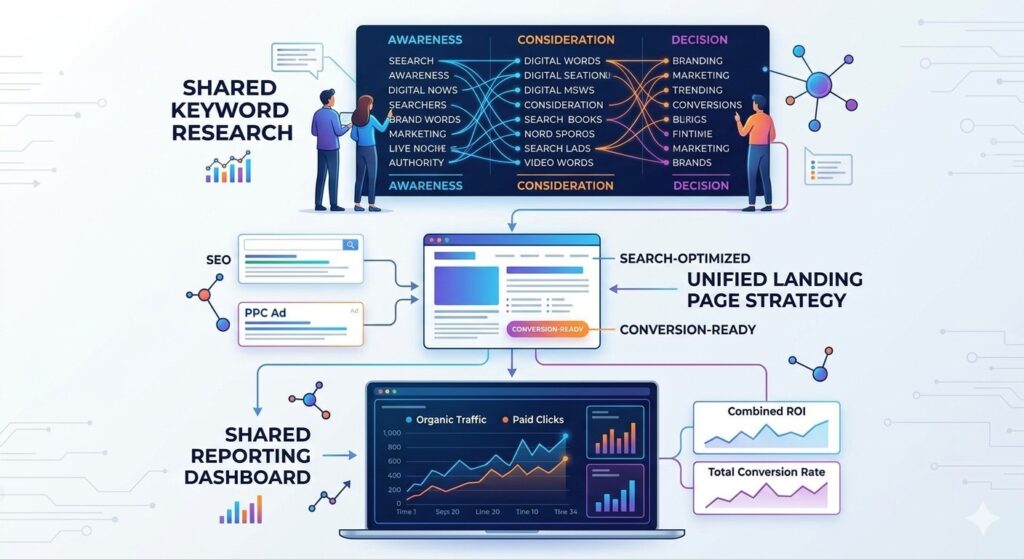
Here is how I build this for clients:
Shared Keyword Research. Build one keyword list. Make it in order: awareness, consideration, and decision.
Unified Landing Page Strategy. Every PPC campaign drives to a page optimised for search.
Shared Reporting Dashboard. Both channels report to one place.
Cross-Channel A/B Testing. Test ad copy variations in PPC first. The winners become SEO titles and headings.
Applying the 70/20/10 rule for content. works 70% on proven tactics, 20% on testing, and 10% on experiments.
The Benefits of Combining SEO and PPC
The ROI Synergy Between SEO And PPC
Brands in both paid and organic positions see click-through rates increase by up to 25%. Users trust brands they see twice. The 80/20 rule for SEO applies directly: 80% of traffic comes from 20% of keywords. Use PPC to defend keywords and test others.
Core Benefits
Full visibility from search to conversion
keyword validation
Improved Quality Scores and lower costs
Stronger brand credibility
Smarter budget decisions
Common Mistakes When Treating SEO and PPC Separately
Bidding on keywords you already rank #1 for. Wasted spend
Different messaging in ads vs page content. Confuses users
No shared negative keyword strategy. Irrelevant traffic
Separate agencies with no communication. Undercutting each other
Ignoring PPC data when building SEO content. Content that does not convert
Some KPIs to Monitor for SEO and PPC Collaboration
Track these in a unified dashboard:
Blended SERP click share
Assisted conversion rate
Landing page engagement
Keyword cannibalisation rate
Cross-channel CAC
Conclusion
The competitive brands use SEO and PPC together. PPC validates, SEO scales, and together they grow results. If you are still running them separately, you are working hard for half the results. The brands that dominate search will not be the ones with the budget. They will be the ones who use SEO and PPC. If you are ready to stop guessing and start growing, Carvicreator provides the solution.
FAQ’s
- What is the 3-3-3 rule in marketing?
The 3-3-3 rule in marketing means you have 3 seconds to grab attention, 3 minutes to keep people interested, and 3 steps to get them to take action. In SEO and PPC, this rule shows why a unified strategy is important. Your ad must grab attention away with PPC. Your landing page must keep people with SEO-optimized content. Your call to action must be clear to guide them. When it combines, the three-stage journey goes smoothly.
- What is the 70/20/10 rule for content?
The 70/20/10 rule for content means you should spend 70% of your time on topics that you know work well with your audience. You should spend 20% on ideas and keywords you want to try. You should spend 10% on experimental formats. When you use this rule with SEO and PPC, it helps you balance what you know works with trying things. You can use PPC data to identify new ideas that work and make use of them in your proven content.
- What are the 4 pillars of content?
The 4 content pillars are education, entertainment, inspiration, and conversion. In an SEO and PPC strategy, these pillars fit naturally across the funnel. Educational content helps people learn and builds trust at the start. Entertaining and inspiring content keeps people engaged. Shows search engines that your content is good. Conversion-focused content is what your PPC ads drive traffic to, turning clicks into customers. All four pillars need to work for your strategy to be as effective as it is required.
- What is the 80/20 rule for SEO?
Organic traffic comes from a small group of keywords, not hundreds of them, just a handful that do the heavy lifting. It tells you exactly where to focus your PPC budget and protect what’s already ranking. Stop spreading effort across everything. This makes your overall keyword strategy smarter and more efficient.