
Instagram has become one of the most effective platforms for businesses that want to reach potential customers and generate leads online. With millions of active users and powerful targeting options, Instagram Ads can help businesses connect with the right audience and turn attention into genuine enquiries.
Whether you run a local business, e-commerce store, salon, coaching business, agency, or startup, a well-planned Instagram advertising strategy can help you generate consistent leads.
In this guide, we’ll explain how to generate leads using Instagram Ads step by step.
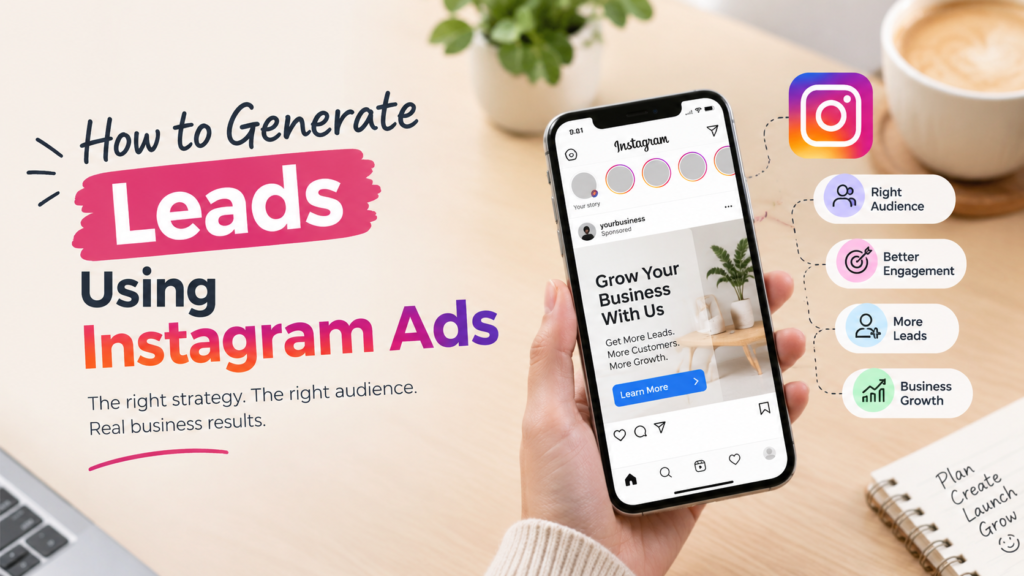
What Are Instagram Ads?
Instagram Ads are paid advertisements displayed across Instagram, including Feed, Stories, Reels, and other placements.
Businesses can use Instagram Ads to promote products, services, offers, websites, or lead-generation campaigns.
Instead of waiting for people to discover your business organically, paid advertising allows you to put your offer directly in front of people who are more likely to be interested.
Why Use Instagram Ads for Lead Generation?
Instagram is particularly useful for lead generation because it combines visual content with detailed audience targeting.
Some key benefits include:
- Reach a specific target audience
- Generate enquiries and customer leads
- Promote products and services
- Increase brand awareness
- Retarget people who interacted with your business
- Control your advertising budget
- Measure campaign performance
For businesses that depend on enquiries, appointments, consultations, or registrations, Instagram can become an important part of their digital marketing strategy.
Step 1: Define Your Target Audience
Before creating an Instagram Ad, clearly define who you want to reach.
Consider factors such as:
- Age
- Location
- Gender
- Interests
- Online behaviour
- Profession or business type
- Previous interaction with your brand
For example, a salon in Bangalore might target people within a specific radius who are interested in beauty, skincare, haircare, and related services.
The more clearly you understand your ideal customer, the easier it becomes to create relevant advertising.
Step 2: Choose the Right Campaign Objective
If your main goal is to collect potential customer information, choose a lead-focused campaign objective in Meta Ads Manager.
Depending on your business model, you can generate leads through:
Instant Forms
Instagram users can submit their details without leaving the platform.
You can ask for information such as:
- Name
- Phone number
- Email address
- Location
- Service requirements
Instant Forms are useful because they reduce the number of steps required from the customer.
Website Leads
You can send users to a landing page on your website where they can complete a lead form.
This approach can be useful when you need more detailed information or want customers to explore your services before submitting an enquiry.
Messaging
You can also encourage potential customers to start a conversation through Instagram or other supported messaging destinations.
This can work particularly well for businesses where customers have questions before making a purchase or booking.
Step 3: Create an Attractive Ad
Your advertisement needs to grab attention quickly.
A good Instagram Ad usually includes:
Strong visual: Use a high-quality image or video that clearly communicates your offer.
Simple headline: Tell users what you’re offering.
Clear benefit: Explain why they should care.
Call to action: Tell them what to do next.
For example:
“Get a Free Consultation Today”
or
“Book Your Appointment Now”
Avoid filling the creative with too much text. Keep the message simple and focused on one main offer.
Step 4: Create a Strong Offer
People are more likely to submit their information when they receive something valuable in return.
Depending on your business, your offer could be:
- Free consultation
- Free quotation
- Limited-time discount
- Product demonstration
- Free trial
- Special package
- Downloadable guide
- Appointment booking
Your offer should solve a specific problem or provide a clear benefit to the customer.
Step 5: Write Effective Ad Copy
Your ad copy should quickly answer three questions:
What are you offering?
Why should the customer care?
What should they do next?
A simple structure is:
Problem → Solution → Benefit → Call to Action
For example:
“Looking for professional digital marketing services for your business? Get customized SEO and performance marketing solutions designed to improve your online visibility and generate more enquiries. Contact us today for a consultation.”
Keep your copy easy to read and avoid unnecessary information.
Step 6: Set Your Budget
You don’t necessarily need a large budget to start.
Start with a controlled daily budget and monitor the results before increasing your spending.
For example, you could test different audiences and creatives with a small budget, identify which combination performs best, and then allocate more budget to the better-performing campaign.
The goal isn’t simply to spend more money.
The goal is to generate quality leads at an efficient cost.
Step 7: Test Different Creatives
One advertisement may perform very differently from another.
Test variations such as:
- Image vs video
- Different headlines
- Different offers
- Different calls to action
- Different audience segments
- Different ad formats
For example, you could create three versions:
Ad A: Product-focused image
Ad B: Short product demonstration video
Ad C: Customer testimonial
After collecting enough data, compare their performance and identify which approach generates better results.
Step 8: Track Important Metrics
Don’t judge your campaign only by likes, comments, or followers.
For lead generation, important metrics include:
Cost Per Lead (CPL)
This tells you how much you are spending to generate one lead.
CPL = Total Ad Spend ÷ Number of Leads
Click-Through Rate (CTR)
CTR shows how frequently people click your advertisement after seeing it.
Cost Per Click (CPC)
CPC tells you the average amount you’re paying for each click.
Conversion Rate
This helps you understand how many people take the desired action after visiting your landing page or interacting with your lead form.
Lead Quality
A low cost per lead isn’t always a good result if the leads aren’t genuinely interested.
Always evaluate the quality of the enquiries you receive.
Step 9: Follow Up Quickly
Generating a lead is only the beginning.
Once someone submits their information, follow up as quickly as possible.
Depending on your business, you can follow up through:
- Phone calls
- Instagram messages
- CRM systems
A fast and professional response can significantly improve the chances of converting an enquiry into a customer.
Common Instagram Ads Mistakes to Avoid
1. Targeting Everyone
Trying to reach everyone can waste your advertising budget.
Start with a clearly defined audience.
2. Using Weak Creatives
Poor-quality visuals or unclear messaging can reduce engagement and lead generation.
3. No Clear Call to Action
Users should understand exactly what you want them to do.
4. Changing Campaigns Too Frequently
Give your campaigns enough time to collect meaningful data before making major changes.
5. Focusing Only on Cheap Leads
A cheap lead isn’t necessarily a valuable lead.
Measure the quality and conversion potential of your enquiries.
6. Ignoring Follow-Up
Even a well-optimized campaign can fail if leads aren’t contacted properly.
How to Improve Instagram Lead Generation
Once your campaign starts generating data, look for opportunities to improve it.
You can:
- Test new creatives
- Refine your audience
- Improve your offer
- Optimize your landing page
- Improve your lead form
- Retarget engaged users
- Monitor lead quality
- Adjust your budget based on performance
Digital advertising works best when you continuously test, measure, and optimize.
Conclusion
Instagram Ads can be a powerful lead-generation channel when they are built around the right audience, creative, offer, and conversion process.
The key is not simply to get more clicks or impressions. Your objective should be to attract relevant people who are genuinely interested in your product or service.
Start with a clear target audience, create a compelling offer, test different creatives, track important metrics, and follow up with your leads quickly.
With consistent testing and optimization, Instagram Ads can become an effective part of your overall digital marketing strategy.